|
''I have seen sports future'' 4 visions
The biggest
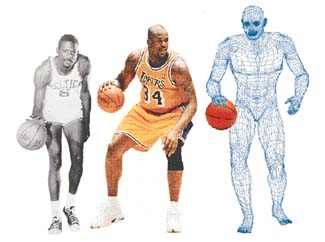
Bill Russell
6'9''
Weight: 220
Boston Celtics center
from 1956-1969
|
Shaquille O'Neal
7'1''
Weight: 315
Los Angeles Lakers center
|
Netherlands player of the future
8'0''
Weight: 400
Microsoft Toronto Raptors forward
|
Giving myself a turn-of-the-century sports quiz
By Michael Holley
Question: Who was the greatest NBA center of the late 1950s and all of the '60s?
Answer: Way too easy. Bill Russell. Wilt Chamberlain may disagree with that, but no one won as often as Russell, who accumulated 11 championships in 13 seasons with the Celtics. No one blocked shots like him, either. The blocked shot is usually considered a defensive art, but Russell brought a ''twoness'' to it. It was clearly defense when he rejected an errant shot; it was clearly offense when he transformed that shot into an outlet pass to his fast-breaking teammates.
Q: So Russell was a dominant figure?
A: Are you well, man? Russell was a basketball genius, a player who performed to a brilliant court rhythm that could be appreciated but never imitated. If I'm making the Russell highlight film, I'm using the music of Thelonious Monk for the soundtrack.
Q: Russell's height and weight?
A: 6 feet 9 inches, 220 pounds. He looked good. He could have called himself Bill Muscle and no one would have wondered if the surname were legal.
Q: Could Russell play in the NBA today?
A: Yes. As a small forward. You know I love Russell, right? But if he played for the Celtics today, he would be the shortest and lightest center on the team and the smallest in the entire NBA. People would call talk-radio stations and complain that the Celtics needed a true center, not an undersized 6'9'' guy. Antoine Walker and Andrew DeClercq outweigh him by 25 pounds and they are both forwards.
Q: Who will be the NBA's greatest, post-Y2K-virus center?
A: An 8-foot, 400-pounder from Scandinavia or the Netherlands.
Q: Excuse me?
A: Young people have made our references to height and weight obsolete. They have also rearranged the familiar adolescent mile markers. One hundred years ago, young women began to menstruate at 16. Today, some are beginning their periods as early as 10. And the Scandinavians and Dutch? They are the tallest people on the planet; their males, on average, are 6 feet tall. One 1998 study claims that height is linked to an overall standard of living. The wealthier and happier you are, it says, the taller you will become. This radical study also notes that height is not necessarily linked to your genes.
Q: And you believe that?
A: Yes. I am poor, moody, and short.
Q: How will this affect the pro sports world in the future?
A: The differences in the NBA will be cosmetic. In simplest terms, you'll see a lot more tall people on the court. Shaquille O'Neal, a 7-foot-1-inch 300-pounder, will be dwarfed by our 8-foot man from the Netherlands. There will also be women playing in the NBA in the next 10 years (have you seen Chamique Holdsclaw of Tennessee play?), forcing the WNBA and CBA to merge into a farm system for the NBA. In the NFL, there will be no such thing as the ''sweep'' play, where running backs head for the corners and outrun slower defensive linemen. Please. There will be no more slow defensive linemen. Already, many linebackers have the speed of running backs. Offensive linemen? Huge. The Patriots once had a Hall of Fame lineman named John ''Hog'' Hannah. He weighed 265 pounds. Five years from now, playing at that size would earn him the nickname ''Tiny'' Hannah. An offensive tackle from the University of Wisconsin, Aaron Gibson, is 6'6'', 386. After two years in the NFL, he'll be up to 400.
Q: What about baseball?
A: They'll have to change the rules. I hope Mark McGwire is not too attached to his home run record of 70, which shattered Roger Maris's 61. It will be broken unless the rules change. Baseball's strike zone is murky; the game's best pitchers are in their 30s; and there are more 50-home run hitters now than ever before. Add those elements toegether and you have another home run record. McGwire's 70 will be topped before 2010. He may even break it himself in the next couple of years.
Q: Just wondering, but could Bill Russell play in tomorrow's NBA?
A: Yes. As a point guard.
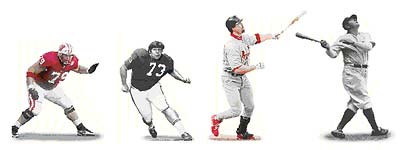
Aaron Gibson
Height: 6'6''
Weight: 386
Offensive tackle at the University of Wisconsin
|
John Hannah
Height: 6'3''
Weight: 265
Patriots offensive guard from 1973-1985
|
Mark McGwire
Height: 6'5''
Weight: 250
St. Louis Cardinals first baseman
|
Babe Ruth
Height: 6'2''
Weight: 215
Boston Red Sox pitcher / outfielder from 1914-1919
New York Yankees outfielder from 1920-1934
|
Holley's 4 visions:
[ The greediest |
The neediest |
The biggest |
The greatest ]
Michael Holley covers the Celtics and writes occasional columns for the Globe.
|