

Click here for past issues of the Magazine.

 Join a discussion about topics in the Sunday Magazine



















|
Click here for past issues of the Magazine.
|
|
|
  

|
Chain of PainUnder "America's toughest sheriff," the nation's only female chain gang labors in the Arizona heat. And the women volunteer for the privilege.Photographs and Text By Stan Grossfeld, Globe Staff
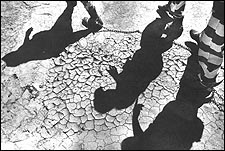
It's 7:15 a.m. in Maricopa County, Arizona, and the man the news media have dubbed ''America's toughest sheriff,'' Joseph Arpaio, has made sure that the members of America's only female chain gang have been up for almost two hours. After a military-style inspection - boots must be shined, bedsheets cornered, hair combed off the collar - and a breakfast consisting of watery eggs, bread, and gray sausage, they are padlocked together, five to a chain, and sent off on the day's assignment. They wear black-and-white, horizontally striped uniforms with ''Sheriff's Inmate'' stenciled on the backs. Before the uniforms were first issued, inmates requested that the stripes be vertical, to make the inmates look thinner. ''I said no,'' Arpaio boasts. ''I'm not here to do what criminals want me to do.'' The women are headed from the Estrella Jail, on the edge of Phoenix, to a paupers' graveyard 20 miles into the desert. The mood on the ride is somber. Chain-gang members spend six days a week performing menial tasks: painting curbs, removing graffiti, picking up trash. But this job is different, because it hits home. The members of the chain gang may be criminals, but they are also mothers and grandmothers; among them, they have 30 children and seven grandchildren. One inmate, 27-year-old Heather Myers, had located the grave of her day-old son, Brendan, on a visit to the cemetery the day before. He died while she was high on crack. Sergeant Maria Novasad, the head of the women's chain-gang unit, offered the inmates some words of encouragement before boarding the bus. ''Take all those bad thoughts you've been carrying around all this time, toss them in there, and bury them,'' she advised. ''If you feel like crying, cry. Tears are OK.'' At the cemetery, Arpaio is waiting. The 66-year-old sheriff, a native of Springfield, Massachusetts, and former deputy regional director of the Drug Enforcement Administration's Boston office, was a federal narcotics agent for 25 years. Colorful and combative, he says he busted one of the leaders of the French Connection drug ring during his tour of duty in Paraguay. His tie clip is in the shape of a gun, but he never carries one. ''If someone wants to plug me, they can plug me,'' he says. The inmates deride his penchant for performing before the cameras; when they spot two sheriff's photographers tagging along with Arpaio, one of them mutters, ''Uh-oh, looks like a Joe show.'' To the cry of ''chain moving,'' the women shuffle off the bus, holding their ears. Overhead, a squad of F-16s from nearby Luke Air Force Base screams past. Arpaio gathers the women together by the grave sites before the work begins. ''Besides saving the taxpayers money,'' he lectures, ''I hope you learn something.'' For the next three hours, the women attend to their grim task. Linked by 5-foot chains padlocked to the inmates' left ankles, the groups have no choice but to move in unison; when one of the women needs to use the Johnny-on-the-Spot, all of them go to the Johnny-on-the-Spot. A backhoe has dug 10 graves; two chains of women remove each coffin from the funeral van and carry it in baby steps to a grave. There they place it on a gurney and remove their white ''Chain Gang'' baseball caps. The deacon says a few words; sometimes a name is given, sometimes not. A prisoner cranks the coffin down into the sandy clay as the women replace their caps and help lower a cement slab into the grave to keep it from caving in. A third chain of women then shovels in the dirt. The scene is bleak. There are no hearses, no tombstones, no families, no friends, no flowers or renditions of ''Amazing Grace''; just 10 holes and an outhouse. ''I feel so sorry that no family showed up,'' says Tina Mathis, who is serving six months for possession of drug paraphernalia and violation of parole. ''Nobody.'' Judy Cuevas, 40, jailed for drug possession, never stops sobbing. One of her chain mates, Natalie Harrington, speaks out loud the words on all the women's minds: ''It could have been me in that coffin.'' Doing time in Maricopa County is harsh, and that's just the way Arpaio wants it. His Wild West tactics may not play well everywhere, but in conservative Arizona - a state that was denied the chance to host a Super Bowl until it recognized Martin Luther King Day as a holiday - the Republican sheriff stands taller than Danny Ainge, coach of the Phoenix Suns. When stenciled prison underwear was being smuggled out of prison and sold on the street, Arpaio made all the male inmates wear pink underwear to humiliate them. Sales of autographed pink boxer shorts with ''Go Joe'' inscribed on them helped to underwrite Arpaio's controversial crime-fighting ''posse'' of 3,200 volunteers - a thousand of whom carry guns. In his 1996 book, America's Toughest Sheriff: How We Can Win the War Against Crime, Arpaio brags about his toughness. When his jails got too crowded, he purchased surplus Korean and Vietnam War tents, which now house 1,000 inmates in summer heat that can reach 120 degrees. Then he erected a huge neon ''vacancy'' sign on the guard tower overlooking his tent city, to let criminals know he would always make room for them. He banned coffee, cigarettes, and skin magazines. To save money, he serves ostrich meat and bologna. He limits inmates' television viewing to House Speaker Newt Gingrich's videos and such ''acceptable'' stations as C-Span and the Weather Channel. He lines the fences of his jails with guard dogs equipped with tiny spy cameras. He calls them ''pup-arazzi.'' ''Jail,'' he likes to say, ''should not be like the Ritz-Carlton.'' Arpaio's district, centered in Phoenix, is larger than the state of New Jersey. He is mentioned frequently as a possible gubernatorial candidate; he ran unopposed for reelection to a second two-year term in 1996 and enjoys a job approval rating of 80 percent. Arpaio insists that if inmates were polled, he would get half of their vote. Among chain-gang members, however, support is nil. ''Cruel'' and ''publicity hound'' are among the more polite terms used to describe him. And it's not only chain-gang members who complain about Arpaio. He has been named in a $20 million wrongful death suit filed by the family of former local football star Scott Norberg. Norberg died of asphyxiation while he was detained at the Madison Street Jail, in Phoenix, in June 1996. According to the suit, Norberg was prodded with a stun gun and forced into a restraining chair with a towel stuffed into his mouth after scuffling with officers at the jail. The coroner ruled the death accidental. ''Those are just allegations,'' Arpaio says. ''They haven't been proven.'' Arpaio was also threatned with a federal lawsuit after a US Department of Justice report cited Maricopa County correction officers for relying on excessive force to control inmates, hog-tying prisoners and employing devices such as restraint chairs, pepper spray, and stun guns. ''I'm not worried about it,'' Arpaio says dismissively about the prospect of a suit. ''Who gave us stun guns and restraining chairs? The Justice Department.'' Last August, Amnesty International USA conducted its own investigation of Arpaio's practices and reached the same conclusions as the Justice Department. ''You don't have to leave the United States to find human rights violations,'' says Josh Rubenstein, director of Amnesty International USA's Northeast regional office. ''They are in jails like those in Maricopa County.'' The report called for a halt to the use of chain gangs, because they are ''in violation of international standards on the treatment of prisoners.'' Arpaio's response to Amnesty? ''Tell them to go back to Iraq and Iran,'' he says. ''I run a harsh but humane jail.'' Chain gangs were phased out in the United States 50 years ago. Alabama was the first state to bring them back, instituting a chain gang for male prisoners in 1995. But when Alabama's corrections commissioner, Ron Jones, proposed a female chain gang, an enraged Governor Fob James rejected the idea, and Jones was demoted. Arpaio, however, sees no reason to treat his male and female inmates differently. ''I am an equal-opportunity incarcerator,'' he proclaims. He formed his first women's chain gang in September 1996. There is no coercion involved; all the women on the chain gang are volunteers, and there is a long waiting list. The chain gang is Arpaio's ''Last Chance'' program for short-term inmates - those serving sentences of a year or less - who have violated jail rules and been sent to lock-down. Each 8-foot-by-11-foot lock-down cell, equipped with a metal toilet, is home to three inmates for 23 hours a day. Women sent to lock-down are given a choice: Remain in near-total confinement or successfully complete a 30-day chain-gang program, to earn a diploma and then return to living in tents. ''They love that diploma,'' Arpaio says. It may seem strange, but many of the women do covet the Certificate of Achievement. ''I worked hard for my certificate,'' says 28-year-old Danielle Gordy, who is serving a two-month sentence for a parole violation. ''I've never graduated school. I've never achieved nothing.'' ''It makes me feel good to be in the only female chain gang,'' says Faythe Simpson, 19, a convicted prostitute. ''I vandalized things and robbed people that didn't know me. I feel like I'm putting back instead of taking from society.'' Before receiving a six-month sentence for credit-card theft and disorderly conduct, Kristin Clark, 23, - was a cocktail waitress in the Cayman Islands. In Hawaiian shirt and split skirt, she served pina coladas to vacationing snowbirds, once pocketing a $100 tip. On the chain gang, she fills water jugs and helps lower coffins into dusty graves. But she isn't about to blame Arpaio for her troubles. ''You are responsible for your whole life,'' she says. The detention officers ''are not here to make you comfy and cozy.'' Some of her jailmates question whether picking up trash or burying paupers is effective rehabilitation. Mary Johnson, 50, serving 100 days for shoplifting - she says she stole a pair of Guess? jeans from a Macy's store - believes the chain-gang work is a waste of time. ''We have regressed,'' she says. ''We have not progressed.'' And while Arpaio's tough-guy approach makes him popular outside prison walls, it has not made crime less appealing. The jail population has risen steadily during Arpaio's tenure, from 4,846 in 1993 to more than 7,100 today. ''Basically, we all have a drug problem, and burying bodies, that's not gonna help with that,'' says Elizabeth Gutierrez, who is serving six months for a parole violation and possession of dangerous drugs. Arpaio says that crime is on the increase because Maricopa County is the fastest-growing county in the country. He suggests that chain-gang members who want to kick their drug habits sign up for his Alpha drug rehabilitation program. As they shovel dirt over the coffins and murmur prayers, the women on the chain gang learn that they will bury only nine bodies this day. The 10th coffin, no larger than a shoe box and labeled, simply, ''Baby Garcia,'' will be returned to the funeral home; according to the Sheriff's Department, family members collected enough money to bury the infant themselves. Many chain-gang members are relieved. But not Heather Myers, who had asked her fellow prisoners to help her bury the infant as a symbolic goodbye to her own baby, Brendan. Brendan lay unclaimed in a morgue for four months until he was buried in a paupers' plot in April 1996 by the male chain gang. The day before, Officer Kelly Sunday allows Myers's chain to search among the tiny markers for Brendan's grave. The women find the golf-ball-sized metal disc in Row 2B, Lot 1, Space 16. One inmate opens her canteen and pours water on the dusty marker as Myers drops to her knees to polish it with her striped prison shirt. Long shadows veil her face. ''He only lived for one day,'' she says quietly, as the women on her chain, knuckles wrapped in toilet tissue, wipe away tears. Myers is serving a six-month sentence for prostitution. She says that one day while she was streetwalking, she got into a man's car. He asked her if she was an undercover officer; she responded by lifting her blouse and inviting him to touch her. When he reached timidly for her shoulder, Myers knew that he was the one undercover and that she was headed for jail. ''I couldn't control using drugs, and it's my fault,'' Myers says at her son's grave site. ''He died because I was doing drugs.'' When she was about to deliver her baby, she was rushed to the hospital for an emergency Caesarean section. ''He had a lack of oxygen and severe brain hemorrhaging,'' Myers says. ''I held him. He had blue eyes. I just wanted to say a final goodbye and tell him I'm sorry.'' She picks weeds from the dry dirt around the grave. The silence is pierced by the call of ''Chain moving,'' as the gang moves in unison to collect rocks for a makeshift cross. Myers again drops to her knees as the women link hands to recite the Lord's Prayer. ''Don't cry,'' she tells the other women, but everyone does. A squadron of F-16s swoops directly over the chained women and drowns out the rest of her words. Back in her lock-down cell, Myers tries to make sense of her thoughts. ''Because I was out doing drugs two years ago, when he was buried, I got to say goodbye Thursday,'' she writes. ''Just like the people we buried Thursday, he was all alone when he was buried, too. Even though I can never really make up for not being there then, I feel I got a second chance to do it Thursday and let go of a lot of pain. ''It does make you stop and think when I was burying those people. I could be one of them if I don't get my life together, and I plan to give it all I got this time when I get out.'' |

|
|
||
 Extending our newspaper services to the web |
Return to the home page
|

|
|