


|
|
|
|
|
CRIMES OF PUNISHMENT Rouse often an absentee sheriff By Sean P. Murphy and Michael Rezendes, Globe Staff, 5/25/2001
His four-hour workday complete, Rouse looked relaxed, standing on the sidewalk in the neighborhood where he got his start in Boston politics, smiling and shaking hands. Then he went into Patty's Pantry, a variety store and political haunt, with no fear that his brand new $26,000 government van with its police plate would be ticketed. Fifteen mintues later, the 47-year-old Rouse loaded up the unmarked van with party platters, then drove to his Jamaica Plain home. At 2:44 p.m., he was home for the weekend, greeted by his daughter and a neighbor who helped unload the food. Based on six days of surveillance by The Boston Globe from May 11 to May 18, it was a typical day for Rouse: a late start, a few hours at work, and home before 5 p.m. What's more, Rouse often used the minivan to ferry his children to school and sporting events - removing the police plate and using an untraceable civilian plate that the Registry of Motor Vehicles issued after being assured it was needed for undercover work. Rouse's lackadaisical work habits were observed during a week that, by any measure, was a time of crisis for the sheriff and his top aides. First, a former female inmate filed a lawsuit charging a guard with sexually assaulting her. A day later, on May 16, the US Attorney brought criminal charges against seven of Rouse's guards for allegedly beating detainees in the county jail on Nashua Street. Yet even the day after the indictments, Rouse left work for the day before 1 p.m. During the six work days that Rouse was under surveillance, he was observed in his Pemberton Square courthouse office for just 14 hours. In addition to the surveillance, interviews and documents reviewed by the Globe portray a department staffed at its highest levels by political and personal friends of Rouse, many with little or no corrections experience, and overseen by a sheriff who is largely absent. In an interview, Rouse's explanation of his work habits did not square with the Globe's observations. But the sheriff insisted that he is on call 24 hours a day, and often attends evening and weekend political events that are part of his job. And he said he is entitled to use the official vehicle and its civilian plate for personal use, even though state and Registry rules forbid it.
Rouse has attempted to distance himself from the sexual abuse and beating allegations that have been leveled against his correction officers, as detailed in Globe articles Wednesday and yesterday. He blamed a few rogue officers while defending his administration. But during an interview with Globe reporters on Monday, Rouse displayed little grasp of his own department's operations. He had to turn to several top subordinates in the room for answers to basic questions about the department such as surveillance procedures and the number of department cars using untraceable license plates.
Rouse, who was appointed sheriff by then-governor William F. Weld in 1996, presides over a $90 million annual budget, most of it state funds. With 1,100 employees, he is responsible for the welfare of 1,600 inmates at the House of Correction in South Bay, and about 650 detainees at the Nashua Street Jail.
In the interview, Rouse said he sees himself as ''an inspirer'' content to leave the day-to-day operations of his department to assistants. And he said he makes up for frequent absences from work by attending after-hours political events, such as last Sunday's Hyde Park parade and a fund-raiser for Boston City Councilor Maura Hennigan last Thursday evening.
''I try to put the best face of this department out to the public,'' Rouse said, adding that the public ''requires'' him to attend political events and community gatherings. Indeed, Rouse cited his regular attendance at such events when claiming to work ''more than a 40-hour week,'' adding that he is on duty as sheriff ''24 hours a day.''
Yet Rouse's account of his activities was sharply at odds with observations made by the Globe during the six days of surveillance. For instance, Rouse said that on May 11, the day he made the trip to Patty's Pantry, he arrived at work ''at about 8 o'clock.'' But in fact, he did not leave his Jamaica Plain home until 9:35 a.m., and only to attend one ceremonial event at the House of Correction before quitting for the day.
''I do remember going home later in the afternoon because I could hardly walk,'' Rouse said. ''My gout was acting up. I went home to get my pills.''
Rouse refused to explain why he used a government vehicle in the middle of a workday to pick up food, exclaiming at one point: ''Oh, come on. What is this? I mean, really. This is getting absolutely silly.''
The day after seven of his guards were indicted, Rouse left his office before 1 p.m., went home for a while, and later spent almost an hour running an errand in Park Square. After that, he said, he used the department van to pick up his daughter at Boston Latin School in the Fenway and drove her to Quincy before returning to Jamaica Plain.
''Thursday is a day that is a difficult one for my wife because she has staff meetings,'' Rouse said, referring to Susan Rouse, a registered nurse. ''Thursday is usually the day that I try not to schedule too many things.''
But Rouse's schedule was also cleared the next day, Friday, so he could attend an annual golf tournament sponsored by the Sheriff's Employees Association to raise money for the family of a former jail officer who died of a heart attack while on duty. Despite the problems facing his department, Rouse spent four hours on the course and two more hours at posttournament festivities at the George Wright Golf Course. By 3:25 p.m., he was home.
Establishing a tone
Critics of Rouse's hands-off style say his inattention to day-to-day operations has set a tone that has contributed to the sexual assaults and beatings that have blotted his department's reputation.
''When you consider the level of supervision built into the system and paid for by the taxpayers, the quality of corrections here is just very, very poor,'' said one knowledgeable department official who asked that his name not be used.
''Nobody really knows where the sheriff spends most of his time,'' the official said. ''He's not around. You don't see him at the facilities.''
The official said Rouse's appearance at the Nashua Street Jail last week to answer questions from reporters about the federal indictments of the seven guards caused a stir within the department. ''People felt it was the longest time he had spent at the jail in a long time,'' the official said.
The official also said Rouse's management shortcomings were underscored earlier this year when he moved his office from the House of Correction to the first floor of the Pemberton Square courthouse in downtown Boston - the heart of a political world where he has long been a comfortable inhabitant.
In his interview with the Globe, held in the library of the House of Correction, Rouse said he moved his office to the courthouse to become better acquainted with a program run for former inmates on the building's seventh floor. ''It's more for my benefit,'' Rouse said, when asked to explain the move. ''To get to know people in the whole department. To get a better sense of everybody and for them to get a better sense of me.''
But neither Rouse, nor any of his aides at the interview were able to say how many offenders use the program - or even how many department employees are assigned to it. Moreover, in a later interview, Superintendent Patrick Bradley said the program will soon be moved to new quarters on the same street as the House of Correction - the very complex recently vacated by Rouse.
The sheriff was also unable to explain why he drives a Ford Windstar minivan - which he described as ''a soccer mom car'' - instead of one of the Ford sedans customarily assigned to law enforcement officials.
Asked about his use of the van, Rouse readily acknowledged he uses it to run personal errands and even for trips to Cape Cod, where he has a summer home. As for the two license plates, he conceded that he often switches his official blue police license plate for an untraceable civilian white plate - 8522RK - issued by the state Registry of Motor Vehicles.
Confidential plates are typically issued to law enforcement officials working in undercover investigations. Kim Hinden, deputy registrar of Motor Vehicles, said the application for Rouse's confidential plate stated that it would be used for such work.
But Rouse said he needed the plate not for undercover work, but because he has been ''subject to threats and things like that,'' adding that, ''people have come to my house at various times. A couple of incidents. Disgruntled inmates.''
The Globe observed Rouse using his confidential plate to drop off his daughter at school in the mornings, to drive to the golf course, and to ferry one of his children to a little league game. But state policy forbids the use of official cars for personal use. And using a confidential plate for anything other than law enforcement work could prompt the Registry to revoke the plate.
Moreover, state law forbids anyone from switching plates on a vehicle. Although Hinden said some law enforcement agencies sometimes do so for undercover work, the Registry would prefer that it not be done. Both the Boston Police Department and the State Police forbid plate switching.
Deep political roots
Rouse's network of lifelong friends and his penchant for hiring them at the Sheriff's Department stamp him as both a product and a vestige of a political culture that flowered in Boston during most of the last century.
With family roots in South Boston, where politics amounts to a sacred rite of passage, Rouse grew up in nearby Dorchester. In 1982, he won a seat in the state House of Representatives.
Comfortable in the network of Catholic parishes and Irish political clans that still defined the city, Rouse fit in easily with legislators like Thomas Finneran, now the House Speaker, and Kevin Fitzgerald of Mission Hill.
But by 1988, the city's demographics had changed substantially. In a gesture greeted with a wink by fellow lawmakers, he gave up his seat, allowing House map-makers to create a minority district without sacrificing one of their own.
In return, the Boston delegation supported Rouse when he ran for clerk of the Supreme Judicial Court for Suffolk County, an obscure political sinecure with a six-year term and a $68,000 salary, double a legislator's base pay.
In 1994, Rouse was part of a coterie of socially conservative urban Democrats who backed the Republican Weld for reelection. Two years later, when Weld was trying to shore up urban support during his run for the US Senate, he returned the favor and named Rouse to the recently vacated sheriff's job.
Like the clerkship, the sheriff's post has a six-year term, which Rouse won unopposed in 1998. But unlike the clerk's job, it gave Rouse wide-ranging authority over the county jail and House of Correction and the patronage potential of a department that now has 1,100 employees.
In Rouse's absence, daily management of the Sheriff's Department is in the hands of Brian Byrnes, a boyhood friend with no experience in law enforcement or corrections before Rouse hired him in 1996. Byrnes is paid $92,800 a year.
Another early recruit to a top post was John R. Haack, a longtime friend who was looking for work after retiring from a military career. Although Haack also had no experience in corrections or law enforcement, Rouse named him as superintendent at the county's House of Correction, the largest correctional facility in New England.
Haack, 59, has known Rouse since the early 1980s, when Haack was commander of Otis Air Force Base on Cape Cod and Rouse, a part-time Air National Guard officer, was assigned to him as administrative assistant. The two men hit it off immediately.
Although Haack was eased out as superintendent at the House of Correction after three years, he maintains his rank as superintendent, his $78,600 salary, and his car. Haack, now in charge of capital planning, and a secretary are the only department employees in Rouse's courthouse office.
Michael Barry, Rouse's teammate on the Cathedral High School hockey team three decades ago, was hired in 1997 as an entry-level correction officer. Later, he was promoted to deputy superintendent - at $72,000 a year.
Before Rouse hired him, Barry owned a South Boston sandwich shop. In an interview, Barry said he wanted to help the drug addicts and alcoholics he saw in the neighborhood every day. But he acknowledged working in Rouse's political campaigns and making regular campaign contributions. Indeed, much of Rouse's political fund-raising list resembles his department payroll: The sheriff has depended on his employees to contribute substantially to the quarter million dollars in his campaign treasury.
Other officials holding important positions in Rouse's department have blemished resumes.
For instance, one supervisor, Richard Flynn, was one of three guards ordered to pay $25,000 each in punitive damages in 1995 to a man charged with murder who was beaten while he was awaiting trial in the Nashua Street Jail. A Superior Court jury found that Flynn stood by as the two other guards beat the man, Albert Lewin. Lewin was subsequently acquitted of the murder charges.
In the last year, Rouse promoted Flynn to captain, according to Richard M. Lombardi, the department spokesman.
Rouse, after defending his own work habits in his interview with the Globe, brushed aside a request that he document his assertion that he works ''more than a 40-hour week'' - whether at Sheriff's Department facilities or political events.
Asked if he would open his appointment book for review, Rouse, visibly agitated, stood up and abruptly ended the interview. ''Thank you very much'' he said, shaking hands with a reporter before walking out of the prison library. ''Keep up your good work.''
Globe reporters Matt Carroll, Thomas Farragher, Francie Latour, Sacha Pfeiffer, and Walter V. Robinson, and Globe photographer John Tlumacki contributed to this report.
Sean Murphy's e-mail address is smurphy@globe.com. Michael Rezendes' e-mail address is rezendes@globe.com.
This story ran on page A01 of the Boston Globe on 5/25/2001.
|
|
| |||
 Extending our newspaper services to the web |
Return to the home page
|

|
|

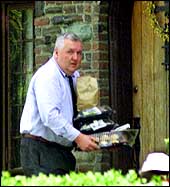

 t 2:05 p.m. on a Friday, the black Ford minivan backed into an illegal parking space on Dorchester Avenue, and out stepped Richard J. Rouse, the $104,000-a-year sheriff of Suffolk County.