PARIS (AP) The 2,000-year-old city that glorifies light,
splendor and fortuitously fermented grapes threw a
millennium-warming on Friday with grand feasts and a street party
such as the world has never seen.
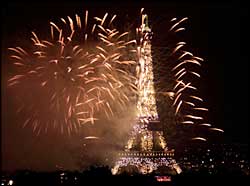
At midnight, the Eiffel Tower itself danced in a dazzling ballet
of fiery colors before popping its cork to spew symbolic bubbles
across a planet in need of some cheer.
Around its base, huge crowds sprayed each other with the real
thing, screamed cheers in a dozen languages and kissed the nearest
person.
Spontaneous partylets burst out all over town as people spilled
out of restaurants and cafes. Crowd of Parisians and tourists then
descended on the Champs-Elysees to keep going until dawn.
''This is the most beautiful city in the world, and you can
overeat to your heart's content,'' Jane Miller, a poet from Tucson,
Ariz., exulted. ''Where else would I be?''
Her friend Jacqueline Tully, a San Francisco private
investigator, nodded enthusiastic accord. Their group of seven
picked a celebration spot years ago, and Paris came up unanimous.
''Something in everyone wants to be in the right place at the
right time,'' Tully said. ''And, my God, this is a millennium.''
Whimsical Ferris wheels dotted the Champs-Elysees to the
Concorde, where a giant illuminated wheel carried revelers high
above the Egyptian obelisk that was 1,300 years old before
Christians kept a calendar.
Just five hours before midnight, the digital countdown clock on
the Eiffel Tower went out after working fine for 1,000 days.
Security officials called it an old-fashioned glitch and expected
it to be repaired.
The entire Paris police force and borrowed riot troops 24,000
in all were out to keep the millions of revelers safe.
Outdoor sound stages blared music to crowds undaunted by clouds
and drizzle. In every part of town, from the rowdy Latin Quarter to
the chic northern neighborhoods, Paris celebrated outside.
And in uncounted dining rooms, old friends worked through
stuffed goose liver, lobster, smoked salmon, venison, game birds,
and holiday delicacies that only the French can concoct.
Just days ago, the mood was less bacchanalia than Armageddon.
Killer winds that savaged France tore out 150,000 trees around
Paris, many planted two centuries ago when the Sun King ruled at
Versailles.
Rains swelled the Seine, flooding its fabled quais and washing
away plans for dinner cruises amid fairy-lit boats. Cracked tree
trunks and blown-down signs smashed cars along the Champs-Elysees.
In a separate calamity, 3 million gallons of spilled oil fouled
the Atlantic coast and rich beds of fines de claires oysters.
But Paris recovers fast. By afternoon Friday, crowds were thick
in the center of town.
Thousands may have flown down to Rio, but Maria-Elena Soares
Gontejo came here. A Brazilian lawyer in flaming crimson, she
strutted theatrically down the Champs-Elysees as a friend filmed
her.
''I love Paris in the winter,'' she said, when asked why she
came. ''I love Paris in the fall. I love Paris. ...'' By then, she
had burst into a song well-known around here.
''I'll be right here at midnight,'' she said, glancing up and
down the light-splashed boulevard. ''I can't think of anywhere I'd
rather be. Just don't talk to me about football.''
The last time Soares Gontejo saw the Champs-Elysees, in July
1998, France was celebrating its World Cup soccer final upset over
Brazil. This time, Frenchmen are just part of the multinational
party.
Still, not everyone was on the street.
At the Chateau de Chantilly, where Francois Vatel fell on his
sword three centuries ago because the seafood was late for a meal
he planned for Louis XIV and 2,000 guests, a modern banquet fared
better.
Alain Senderens, the three-star chef of Lucas Carton, cooked the
sumptuous meal, but most eyes were on the wines: Montrachet 1990,
Petrus 1988, Haut-Brion 1982, Latour 1970, Romanee-Conti 1971,
Chateau d'Yquem 1967.
For the stroke of midnight, there was Lafite-Rothschild 1873,
worth perhaps $6,000 a bottle, and Chateau d'Yquem 1884, which
comes a little cheaper.
At $3,075 a plate, wine included, waiters served 150 people.
''It was half-full, not half-empty,'' said Catherine Sick, an
organizer. ''We take an optimistic view considering how many people
did not travel as they had first planned.''
The Bal du Roy, a nine-hour meal for 1,000 people at the
storm-battered Versailles Palace, was modeled on a glory-days feast
that Louis XIV might have given.
For $2,300, diners made do with Chassagne-Montrachet 1996, Smith
Haut-Lafitte 1995 and Dom Ruinart 1990 Champagne. But they consoled
themselves with royal medallion of sea bass with Sevruga caviar and
sea scallops in a sauce of Asian citrus preserves.
Farther down the food chain, people did the best they could.
Francois Chaplain, a shopkeeper, drove his wife and his three
kids down from Brittany. They planned to party at a friend's house
but did not want to miss the spectacle on the streets.
''Paris is a great place to be, I suppose,'' he said. ''I came
here because I couldn't make it to New York.''