
| | 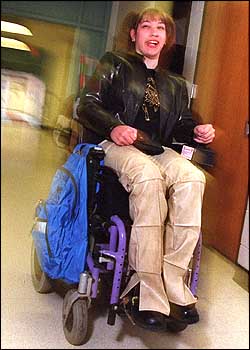
(Globe Staff Photo / John Blanding)
|
Recording for the Blind and Dyslexic has provided Nicole Tarzia, 19,
with books on tape that have allowed her to overcome the obstacles
of her disability and excel academically.
 hen I was in elementary
school I was put into low-reading groups � you
know, the ones every kid
dreads to be in � and I always felt like I wasn�t good enough. I felt like
giving up. There was no solace for me �� until
Recording for the Blind and Dyslexic stepped in.
hen I was in elementary
school I was put into low-reading groups � you
know, the ones every kid
dreads to be in � and I always felt like I wasn�t good enough. I felt like
giving up. There was no solace for me �� until
Recording for the Blind and Dyslexic stepped in.
Tarzia was diagnosed with cerebal palsy at
six months old. Doctors told her parents her intelligence would be low, she�d be wheelchairbound, and she�d never have a normal life. But
with the help of Recording for the Blind and
Dyslexic, a national nonprofit organization,
Tarzia, now 19, has proven them wrong.
�I was a struggling elementary school student, and I graduated high school with a 3.95
grade point average,� she says, laughing.
Now a sophomore at Bridgewater State College, pulling a 4.0 GPA, Tarzia is majoring in
both psychology and social work, and after
graduation plans to open a clinical practice for
children with disabilities.
�I want to be that rock for that child who has
no one to turn to,� she says.
Blessed with a fighting spirit, Tarzia says she
owes it all to RFBD, which provided her with academic books recorded on cassette tapes.
With a library of over 80,000 recorded books,
and more than 250 volunteers throughout the
region, RFBD has provided numerous textbooks
for both the visually impaired and those with
physical and learning disabilities. A service all
too often overlooked, RFBD has helped hundreds of thousands nationwide overcome the
obstacles of their disabilities and continue their
education with remarkable success.
Says Tarzia, �I know how much I�ve struggled
and I�ve accomplished, despite my disabilities.�
Megan Tench
This story ran on page F7 of the Boston Globe on 11/18/2001.
© Copyright 2001 Globe Newspaper Company.
|



 Dow:
Dow:





