
Fortunate seek guidance in giving away their wealth
Groups spring up to help individuals with means to help others
By Dolores Kong, Globe Staff, 11/18/2001
| |
|
|
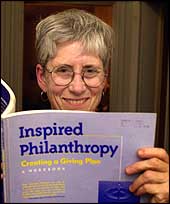
Penny Yunuba, 60, of Jamaica Plain, created a discussion group based on the book "Inspired Philanthropy". (Globe Staff Photo / John Blanding)
Change of heart
It used to be we worried about other things, like what was on the racks at the mall. Now we're not buying as much, but we are giving money away like mad.
Internet surge
Since Sept. 11, charitable donations have been pouring in over the Internet. But will online giving have a sustained impact on nonprofits?
Keeping faith
A unique mission to join secular foundations with black churches is boosting services to some of Boston's poorest neighborhoods.
Market pressures
Endowments are having one of their worst investment years in a decade. Here's how people responsible for investing the money are managing.
Education collaboration
How the Boston public schools and the local business community finally got working together.
The new Boston
It's not always easy to get residents who work in Boston and identify themselves with the city to abandon their longtime patterns of giving.
Corporate outsourcing
Donor-advised funds have become wildly popular with individuals over the last decade. Now some companies are trying them, too.
The nonprofit 100
A ranking of the top Massachusetts nonprofits by public support, revenue, expenses, and assets.
|
 n years past, when mailings from charities arrived during the holidays, Janet Grey used to give to whatever groups struck a chord with her until her funds ran out. n years past, when mailings from charities arrived during the holidays, Janet Grey used to give to whatever groups struck a chord with her until her funds ran out.
''It was giving through guilt, I think,'' said Grey, a Jamaica Plain resident and retired Brookline elementary school teacher. ''What I found happening was that I only have so much money at Christmas time. It really isn't a very useful way of making contributions.''
Then she got an e-mail about the formation of an ''Inspired Philanthropy'' group, and she signed up. Now she has a giving plan, purposefully donating larger sums throughout the year, totaling 5 percent of her income, to specific organizations.
Around the country, whether through small discussion groups and so-called giving circles, or the thousands of newly formed family and community foundations, countless people like Grey are seeking guidance.
Charitable giving is no longer just about old money being courted by organized philanthropy, the new-economy rich setting up a venture philanthropy fund of their own, or the working class donating a part of their paychecks to a workplace charity campaign.
''I think what is happening is people are starting to explore what giving means to them,'' said Siobhan O'Riordan, director of Giving New England, a project of Boston-based Associated Grantmakers of Massachusetts. ''It's really a personal process.''
There's plenty of evidence of the growing interest:
More than 300 requests for kits on how to start a giving circle have been placed over the last few years with Giving New England (www.givingnewengland.org). Giving circles are a kind of social investment club, in which members pool money and decide together how to give it away.
More than 20,000 foundations have been created nationwide since 1996, with assets of more than $38 billion, according to statistics from Jankowski Associates. Massachusetts ranks among the top 10 states, with assets of $1.1 billion spread over the 950 foundations created in the state since 1996.
Several community foundations have been established in Massachusetts during the last few years. There are now more than a dozen tax-exempt public charities focusing on local needs, said George McCully, trustee of the Ellis L. Phillips Foundation in Boston and coordinator of the foundation's annual ''Catalogue for Philanthropy.'' Community foundations can help individuals set up donor-advised funds, allowing people to get a charitable deduction the year the fund is set up and suggest distributions at any time.
New groups such as the Philanthropic Advisors Network and the National Network of Philanthropic Planners have cropped up to provide giving guidance, with members coming from such fields as law and financial planning. A new professional designation, the Chartered Advisor in Philanthropy, is being offered by the American College, a Pennsylvania-based resource for financial service and insurance education.
Why the explosion in interest?
Part of it has to do with the tremendous creation of wealth over the last decade, despite the recent downturn in the stock market and the economy. According to statistics cited last year by The Philanthropic Initiative, 5 million millionaires and 350,000 individuals with a net worth of $10 million or more live in the United States.
Some of it stems from the intergenerational transfer of wealth that's expected to occur - an estimated $41 trillion to $136 trillion over the next 50 years, potentially creating a ''golden age of philanthropy,'' according to research by Boston College sociology professor Paul G. Schervish and senior research associate John J. Havens.
When people believe they have enough money to meet their needs, it's only natural that they seek guidance in giving some of their wealth away or otherwise doing good with it.
Take the case of Christopher Mogil, who inherited enough money from his grandparents two decades ago, when he was 23, to place him among the wealthiest 5 percent of Americans.
''It was an experience of sudden wealth,'' said Mogil, whose grandfather had invested wisely in the stock market and whose grandmother's family made its money from a variety of businesses. ''I was doing community work in Philadelphia, living simply. It seemed enormous to me.''
He didn't know what to do with his newfound wealth. ''I desperately needed to talk to other people in my situation,'' Mogil said. He formed a support group, which he and his wife, Anne Slepian, in 1991 turned into the Arlington-based national nonprofit More than Money, to help people with wealth contribute money and talent ''toward creating a more sustainable and just world.''
About 1,500 people who identify themselves as being among the wealthiest 5 percent - household net worth of $898,000 or more, and household gross income of $127,000 or more - belong to the group.
More than Money provides other types of support for people with wealth beyond guidance. Its next national conference, in Cambridge in April, features a workshop on giving as well as sessions on financial planning and management, money and relationships, and other topics.
There's another recent Massachusetts initiative. Every year, a free ''Catalogue for Philanthropy'' is sent to the 120,000 Massachusetts households with incomes of $150,000 or higher. This year's catalog, arriving this month, will profile 65 charities and 10 new venture philanthropy projects, said McCully, the catalog's coordinator.
''There are people out there who would love to get involved in philanthropy but don't know how. They need help,'' said McCully, who has also devised a national Generosity Index, which has consistently shown Massachusetts at or near the bottom.
But it's not just people with high net worth or six-figure incomes who are seeking guidance. Penny Yunuba, 60, of Jamaica Plain, a devotee of living simply who spends only about $9,000 a year, was the organizer of the Inspired Philanthropy group that Janet Grey participated in.
''What if you had enough and knew you had enough? How would you figure out how to give it away?'' said Yunuba, recalling what prompted her to seek out the ''Inspired Philanthropy'' workbook by Tracy Gary and Melissa Kohner and create the discussion group based on it.
Joining Yunuba and Grey at the meetings is IBM software developer manager Clark Cole. ''I'm always trying to figure out ways to improve my giving,'' said Cole. Over several months of meetings, participants were to come up with a personal mission statement and a plan for giving.
As a result, Cole, 39, a Boston resident and a longtime volunteer and giver, donates 10 percent of his income, much of it to his church and the rest to 25 groups.
''Somewhere I heard that if you give away 10 percent, you manage the rest of your money better than ever before,'' said Cole. ''That seems to be very true.''
Dolores Kong can be reached by e-mail at [email protected].
This story ran on page F5 of the Boston Globe on 11/18/2001.
© Copyright 2001 Globe Newspaper Company.
|



 Dow:
Dow:





